
Care Guide
Light
Provide bright, indirect light.
Abundant filtered light supports strong growth and healthy foliage.
Some gentle direct sun may be tolerated when the plant has been properly acclimated, but protect it from abrupt exposure to prolonged harsh sunlight that could scorch the foliage.
Water
Allow the upper portion of the potting mix to begin drying before watering thoroughly.
Water until excess drains freely and avoid keeping the roots continuously saturated.
Billietiae appreciates moisture but also needs oxygen around its roots.
As always:
Check the soil rather than watering according to the calendar.
Temperature, light, pot size, season, and active growth will all influence how quickly the plant uses water.
Humidity
Moderate humidity is appreciated, and somewhat higher humidity can support healthy foliage and new-leaf development.
Billietiae can adapt to normal household conditions when its other needs are being met.
Good airflow remains important.
Temperature
Warm, stable household temperatures are best.
Protect the plant from cold drafts and abrupt temperature changes.
Fertilizer
Feed periodically during active growth with a balanced houseplant fertilizer according to the product directions.
Avoid excessive feeding in an attempt to make those leaves grow enormous overnight.
Billietiae is perfectly capable of becoming impressive on its own schedule.
Our job is to give it what it needs to get there.
Growth Habit
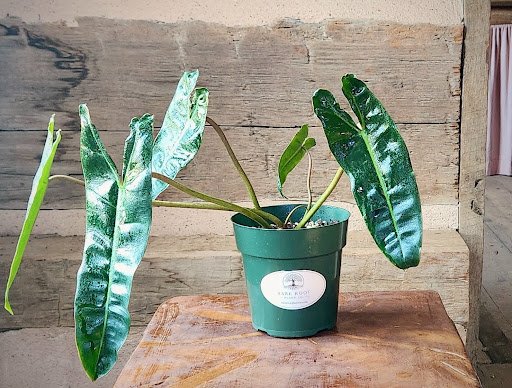
Philodendron Billietiae is a climbing Philodendron.
Providing a sturdy moss pole, plank, or other vertical support allows it to follow its natural climbing habit and can support mature growth.
But don’t think only vertically when planning its space.
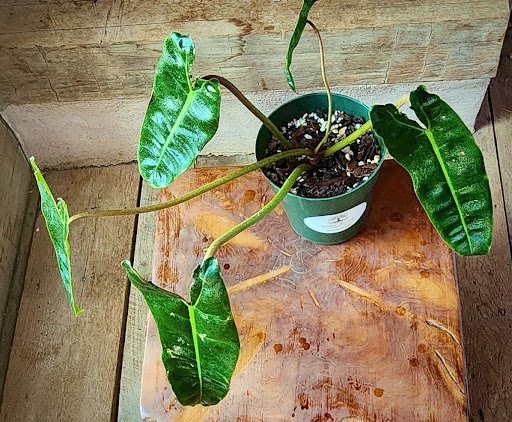
Those elongated leaves can extend considerably outward from the plant.
In other words:
The moss pole may fit in the corner.
The Philodendron has not agreed to remain within the dimensions of the moss pole.
Give those leaves room to be what they are.
Those Orange Petioles
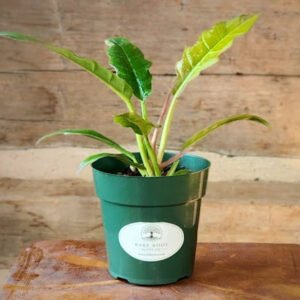
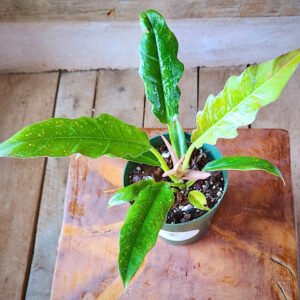
One of the defining ornamental features of Philodendron billietiae is its distinctive orange to orange-yellow petioles.
The petiole is the stalk connecting the leaf blade to the main stem.
Color can vary with age and growing conditions, but those warm-toned petioles create the beautiful contrast for which this species is known.
New Leaves
New foliage may emerge differently in color and texture before hardening into its mature appearance.
Allow new leaves to unfurl naturally.
Do not pull, peel, or otherwise “help” a developing leaf open.
We understand the temptation.
We reject the temptation.
We then check again fifteen minutes later because apparently staring at it is completely different.
Pet Safety
Not pet friendly. Like other Philodendrons, Philodendron billietiae contains insoluble calcium oxalate crystals and can cause painful oral irritation if chewed or ingested by cats or dogs.
Keep it away from pets and small children likely to chew foliage.
Reviews
There are no reviews yet.